Why Colin Kaepernick Could Be a Free-Agent Mirage
Think back four years ago. For a moment, try to forget what you know now about San Francisco 49ers quarterback Colin Kaepernick, and shut off the hindsight part of your brain.
What do you see?
Surely you see some uncertainty, which is always the case with an athletically gifted but still raw quarterback. However, any questions are overpowered not just by the dazzling skills in Kaepernick's toolbox but, more importantly, by how he used them.
TOP NEWS
Predicting NFL Roster Cuts ✂️
.jpg?w=2560 "Bills Browns Football")
Shedeur's Reaction to Browns' QB Decision
Biggest Rumors Ahead of Roster Cuts 👀
The quarterback who excelled more so with his feet than his arm wasn't a new concept. How Kaepernick went about his speed-based brand of flair-filled football was different, though, and something we hadn't seen much before.
He needed a stride or three to get into his highest gear. But after that he was a 6'4", 230-pound bounding gazelle able to cover wide swaths of the field in mere seconds. The then-25-year-old set a single-game rushing record for quarterbacks, posting 181 yards on the Green Bay Packers during the 2012 divisional round.
As a thrower he lacked accuracy, a common early-career issue for mobile quarterbacks, but that problem was mitigated or at least masked by having a catapult attached to his body. He averaged 8.3 yards per attempt during the 2012 regular season, and he posted a still solid 7.7 yards in 2013 while throwing 21 touchdown passes and eight interceptions.
He was the 49ers' fresh golden-armed hero. It was easy to buy in and believe a franchise had set itself up with a firm foundation for the next decade or more at the sport's most important position.
But believing required overlooking core flaws that defenses would eventually expose, with field vision in the pocket chief among them. The common thought, or at least hope, was that Kaepernick would develop as a passer to become a dynamic and complete quarterback.
Let's return to the present day. Instead of progressing, Kaepernick has largely regressed. He's set to turn 30 years old midway through the 2017 regular season, an age when quarterbacks are what the tape and data say, and trying to reverse regression is an exercise that leads to baldness.
But in a league where searching for even serviceable quarterback play on the open market each March typically ends in sleepless nights spent staring into the depths of the universe, Kaepernick will still be a coveted prize on March 2.
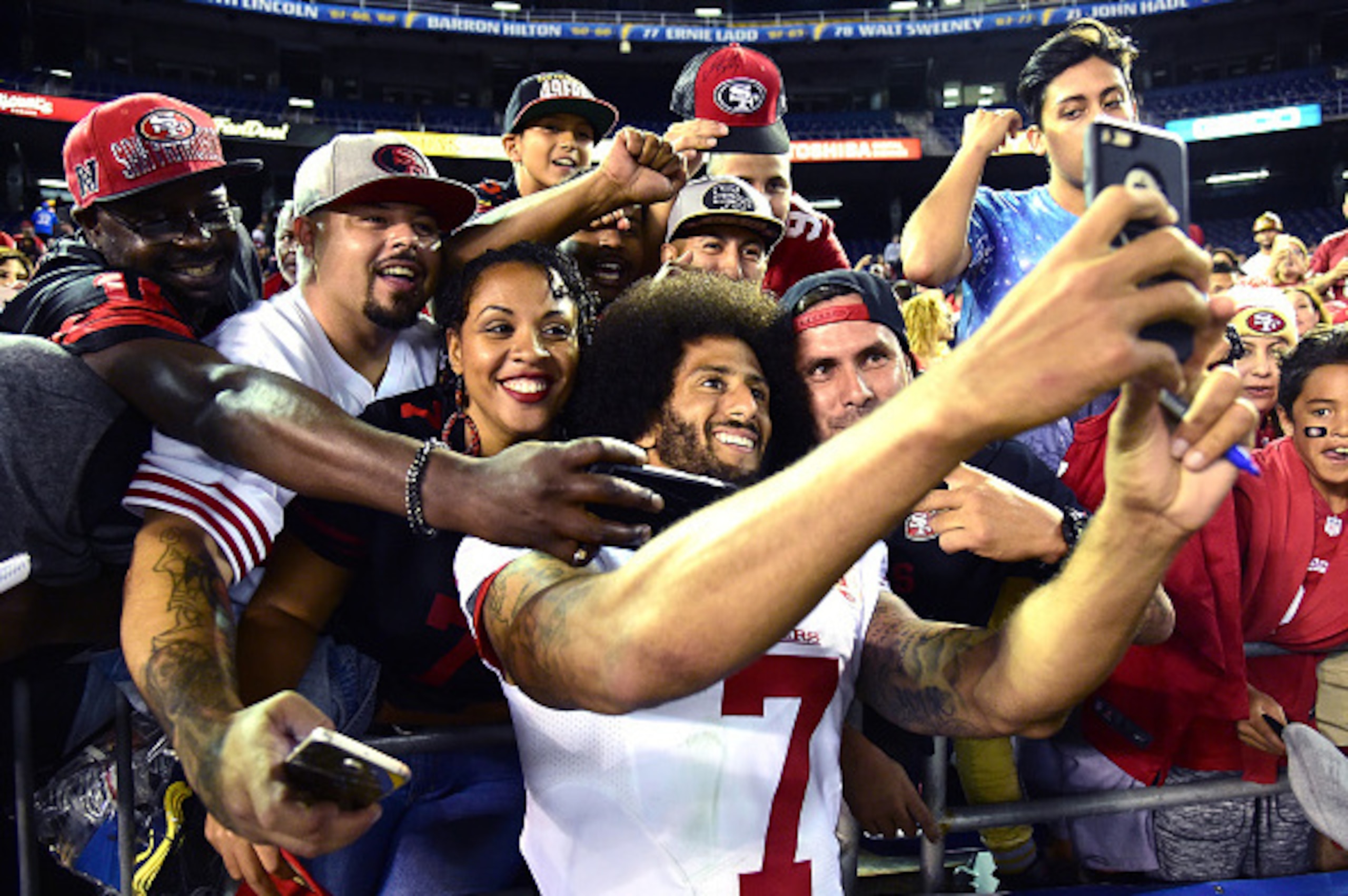
That's when Kaepernick can opt out of his 49ers contract and become a free agent. His departure has felt like a formality since he agreed to a restructured deal in October. That's when the 49ers gave him a player option for 2017, which, essentially, came in exchange for Kaepernick's giving up the injury guarantees in his previous contract.
He will take the exit strategy given to him, according to a report from ESPN.com's Adam Schefter and Chris Mortensen, and become a free agent. Unchecked quarterback desperation will surely make a general manager fool himself into thinking Kaepernick is the answer to a long-standing problem.
Let's go ahead and make the very, very safe assumption Kirk Cousins returns to the Washington Redskins, likely through a long-term deal. When that inevitably happens, Kaepernick will find himself as the shining jewel on the quarterback market amid a bunch of cubic zirconias.
| Colin Kaepernick (can opt out March 2) | $11.9 million |
| Ryan Fitzpatrick | $12 million |
| Mike Glennon | $1.5 million |
| Brian Hoyer | $1.5 million |
| Geno Smith | $675,000 |
Only one quarterback on that list not named Kaepernick was deemed worthy of a $10-plus million base salary in 2016. That ended up being a colossal mistake by the New York Jets in their handling of Ryan Fitzpatrick.
The league's quarterback-starved teams are already spending long nights and early mornings trying to project Kaepernick's value and just how much risk they should take on. That assessment has been made difficult and confusing by what appeared to be a rebound season in 2016.
Looking past the surface, we see that, like his free-agent peers, Kaepernick is also likely a fake diamond.
The surface shows a quarterback who performed well considering the embarrassing roster around him and a crumbling franchise. That's true, as Kaepernick threw just four interceptions after needing only eight starts to throw five picks in 2015. His passing touchdowns (up from six to 16) and passer rating (up from 78.5 to 90.7) also improved considerably over the previous season.
| 2015 | 179.4 | 6.6 | 59.0 | 78.5 | 6 | 5 |
| 2016 | 186.8 | 6.8 | 59.2 | 90.7 | 16 | 4 |
It doesn't take much digging to find the warning signs, though, and the indications that 2016 could be an outlier for Kaepernick far removed from the norm. That starts with air yards.
Air yards aren't the ultimate barometer, as to some extent they can be a product of the offense a quarterback is in.
But they can still give us a solid gauge for how accurate a quarterback is on intermediate and deep targets, as concerns hover around anyone who truly plunges to the bottom of the league. Questions then arise about natural field instincts, the ability to finesse passes into tight holes with the proper touch and, more generally, how well the quarterback can march an offense downfield in a critical late-game situation.
New England Patriots quarterback Tom Brady has nearly unmatched skill in all of those areas and demonstrated it repeatedly during Super Bowl LI. Brady finished the 2016 regular season with a modest 1,914 air yards, according to Pro Football Focus, which was lower due to the nature of his offense, but mostly because he missed four games.
The Brady comparison shows how far Kaepernick is from the top—and from being even in remote consideration for the franchise-quarterback label. Brady and Kaepernick had almost identical seasons in terms of playing time, as both quarterbacks appeared in 12 games (Kaepernick's 11 starts were one behind Brady).
Brady still finished a whopping 790 air yards ahead of Kaepernick.
| Eli Manning | 2,053 | 51.0 |
| Ryan Tannehill | 1,527 | 51.0 |
| Colin Kaepernick | 1,124 | 50.2 |
| Matthew Stafford | 2,171 | 50.2 |
| Sam Bradford | 1,939 | 50.0 |
| Alex Smith | 1,626 | 46.4 |
Only a tick over half of Kaepernick's overall passing yardage in 2016 (2,241 yards) came through the air. That's where we begin with the likelihood of another regression, and evidence shows what we saw in 2016 was a blip rather than true progression.
Kaepernick's lack of chunk-yardage passing led to a per-attempt average of 6.8 yards. That represented a minor improvement over his woeful 2015 season (6.6 yards), but it was still far behind his performance peak from 2013 (7.7 yards).
In fairness, a leaky offensive line didn't help matters for anyone involved in the 49ers' stale passing attack. Kaepernick was sacked 36 times and faced pressure on a painful 42.4 percent of his dropbacks, per PFF, the league's second-highest percentage.
What's troubling, however, is that when Kaepernick faced a clean pocket he didn't fare much better. In fact, he was horribly inept while standing in the middle of nothing but pristine space.
| Colin Kaepernick | 66.4 |
| Brock Osweiler | 64.1 |
| Ryan Fitzpatrick | 62.7 |
| Blake Bortles | 62.7 |
| Cam Newton | 60.9 |
That reflects what we've always known about Kaepernick: He lacks field vision, and his ball placement is inconsistent during even the best of times. He also completed a lowly 36.7 percent of his pass attempts in 2016 that traveled 20-plus yards through the air, again per PFF.
Recency bias is a dangerous drug in the NFL, especially when it feeds quarterback optimism. Kaepernick's 2016 season wasn't quite as good as it seems, and beyond that the larger sample of his work is dotted with inadequacies that cloud his viability as an NFL starter.
We don't have to look far back to see them either. Over a two-year stretch between 2014 and 2015, his completion percentage ranked 26th and 31st among quarterbacks who took at least 25 percent of their team's snaps. Kaepernick is also one year removed from a season with three games when he was sacked five-plus times.
He'll still get paid, and paid well, possibly by the Jets after they hired former 49ers wide receivers coach John Morton to be their new offensive coordinator.
That's what happens when the skills needed to be even an adequate quarterback are in such short supply. Those who barely rise above the low bar are elevated, and to great financial gain, because at worst they can be a short-term solution until someone better comes along.
Or until the next mediocre quarterback falls into the free-agency weeds again in a few years. For some teams the replacement-level quarterback carousel spins forever, and they're left wishing upon twinkling, fading former stars like Kaepernick each spring.
.png?w=2560 "Bills Browns Football")
.jpg?w=2560 "Grading WWE Raw 🔠")
.jpg?w=2560 "Source: Freedom, White Not Eligible for WNBA Draft (AP)")